
Practical article
BIM execution plans: specify the information you need
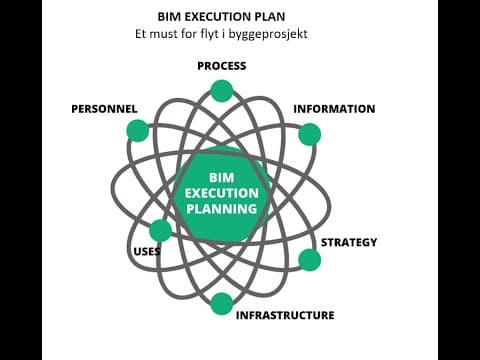
A model can look complete and still lack the information needed for estimating or operations. A good BIM execution plan therefore starts with the decisions the model should support, turning needs into deliverables that others can produce and check.
In the presentation on BIM Execution Plans, Sindre Gundersen shows a practical approach: clarify the purpose, draw the information flow and specify the necessary properties. The plan, often abbreviated BEP, then describes how the project will work with information.
Start with how the information will be used
If the owner needs to compare areas, the deliverable must provide comparable areas. If the contractor needs to estimate costs, quantities must connect to the items being priced. If operations staff need to find documentation, the connection between building elements and documents must be understandable.
Gundersen's early design example makes this concrete. Scans and models provide an overview of existing conditions. A table specifies areas by floor and room, the objects to which information should be attached, and square metres as the unit. The need is therefore more precise than a general request for “a BIM model”.
A practical way to prepare the brief is to collect these clarifications:
- Which decision should the information support, and who will make it?
- Which objects, properties and units does the recipient need?
- When must the deliverable be available, and who is responsible for it?
- How will the recipient check whether the information is usable?
This is a proposed working basis, not a complete requirements template. It needs to be made specific to the project's tasks.
Move recurring decisions to the owner
Many choices recur from one project to the next. In the presentation on owners' information requirements, Gundersen uses door ordering as an example. When owners, users, consultants and suppliers must clarify important properties close to ordering, many roles depend on each other's answers at the same time.
He proposes resolving more within the owner's organisation beforehand. Some requirements may be shared across the portfolio, while other choices should remain with the user. The question is which properties can be decided early and which require knowledge from the individual project.
Organisational information requirements, OIR, offer a starting point for this discussion. For building owners, this includes the knowledge needed to manage properties throughout their lives.
Connect project delivery to operations
In Knud Mohn's talk on ISO 19650, needs are connected to agreed information deliverables. He also shows a common data environment with controlled flow between work in progress, shared information, published deliverables and archives.
An important distinction is between the project information model and information supporting ownership, operations and use. A good execution plan should therefore make the transition to operations a task that can be planned and followed up.
Mohn also distinguishes model maturity from information needs. A maturity level alone does not tell you which properties a recipient needs. The specific use still needs to be described.
Try one deliverable before the plan grows
A useful first step is to choose one information deliverable, such as areas for a cost assessment. Let the sender and recipient review it together: can the recipient find the right objects, understand the values and use them in their task?
The experience can inform adjustments to the requirements and plan. The BEP becomes a working tool that develops with the project, with a clear connection between what is specified and what the information will be used for.
The source material consists of presentations from 2021 and 2023. The discussion of ISO 19650 follows those talks; it does not reproduce a complete or up-to-date standard.