
Practical article
Product information from ordering to operations
A building owner needs to know which products were actually delivered and installed. That knowledge is built through many steps: requirements, ordering, order confirmation, receipt and documentation. When information follows the product, both the project and operations have a better foundation to work from.
Contech #19 from January 2021 shows several of these steps. Knut Mathisen from GS1 Norway explains product identification, Frode Ødegård from XL-BYGG Dale Malo demonstrates electronic orders, and Sindre Gundersen from Angvik Utvikling addresses requirements that must be clarified before ordering a door.
Identify both the product and the delivery
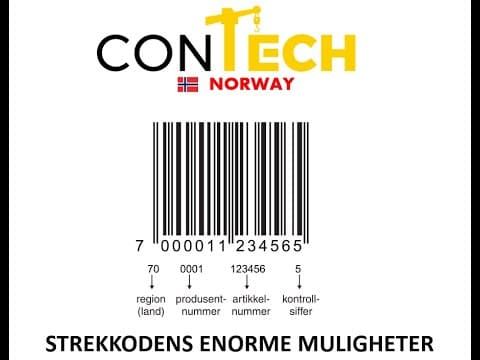
Mathisen distinguishes identification, data capture and data sharing. GTIN identifies a product, while a serial number can distinguish an individual item from otherwise identical products. A test order from NorDan illustrates how identification can accompany made-to-order windows.
The point is to connect information to what it concerns. A product description, a specific item and its location in a building answer different questions. Once these relationships are clarified, it becomes easier to find documentation for the actual delivery.
The NorDan documents in the film are marked as tests. They demonstrate the principle and are not used here as evidence of a completed construction site delivery.
Read the changes in the order confirmation
Ødegård's example starts with an order from an estimate and message exchange through Logiq. The order confirmation then shows the supplier's response to individual order lines.
A door is cancelled, a bend is replaced and freight is added. The example shows why a lower total does not necessarily mean the purchase has become cheaper: items may be missing or the contents may have changed.
For the recipient, the difference between order and confirmation therefore matters. Which lines have changed? Will the replacement product work in the planned solution? Who needs to approve the change before the project moves on? The electronic message makes the discrepancy visible; the working process must ensure someone handles it.
Clarify the function before ordering individual parts
In the presentation on building materials merchants' role, Ødegård uses a gutter to illustrate customer needs. The customer needs a working solution, and the merchant knows which parts are required.
The same perspective is relevant to doors. Dimensions, fire, acoustics, locks and automation involve different parties. When important decisions come late, many questions must be resolved just as the order becomes urgent.
Gundersen proposes separating requirements the building owner can standardise from choices that should remain open to users. This is explored in the presentation on owners' information requirements. Earlier decisions are intended to improve flow and reduce unnecessary variants. It is a proposed way of working; the recordings do not document a completed standardised door delivery with measured benefits.
Test the whole information flow on a small scale
Ødegård's advice in Contech #19 is to complete an entire electronic workflow on a small scale and learn from the trial. This offers a practical way to examine connections between systems and responsibilities between parties.
In such a trial, the project can follow one delivery and ask:
- Can the order be traced to the agreed requirements?
- Are changes in the order confirmation detected and handled?
- Can the recipient connect the product to the right delivery and planned location?
- Can the owner find documentation for the product that was actually delivered?
Together, the answers provide a better picture than a single demonstration of scanning or message exchange. The presentations from 2021 point towards a value chain in which products and information are followed up as parts of the same delivery.